Fast Stress Relief for Busy Days: 60-Second Reset

Break the Tension: Fast Stress-Relief Tools for Busy Days
Stress can spike in minutes—before a meeting, during a commute, or while juggling deadlines. The most helpful skills are the ones that work quickly, fit into real life, and can be repeated without special equipment. Below is a flexible “stress reset” routine built from practical breathing, short meditations, grounding methods, and simple time-management moves you can use almost anywhere.
A quick way to tell: stress, anxiety, or overload?
Not every tense moment needs the same tool. A fast check-in helps you choose a response that actually matches what’s happening.
Common body signals
Tight jaw or shoulders, shallow breathing, racing heart, stomach tension, headache, restless legs, or sudden fatigue can all be signs your nervous system is revving up.
Common mind signals
Looping thoughts, irritability, a sense of urgency, trouble deciding, inability to start tasks, and “brain fog” often show up when your brain is trying to solve too much at once.
A helpful frame
The goal isn’t to erase stress—it’s to lower the intensity so you regain choice in your next action.
When to seek extra support
If you experience panic symptoms that feel unmanageable, persistent insomnia, frequent chest pain, or stress that interferes with daily functioning, consider reaching out to a qualified healthcare professional. For a quick overview of how stress can affect the body, see the American Psychological Association’s guide.
The 60-second reset: posture, exhale, and a single intention
This is a “break glass in case of stress” sequence—simple enough to do while your coffee brews or before you open an email.
1) Change input fast
Plant both feet. Drop your shoulders. Unclench your tongue from the roof of your mouth. Soften your gaze (you don’t need to stare intensely at anything).
2) Prioritize the exhale
A longer exhale is one of the quickest ways to signal safety to the nervous system. Start with one slow breath out before you try to “breathe deep.”
3) Choose a tiny intention
Pick a short phrase that reduces friction: “slow down,” “one step,” or “just this minute.” The point is to create a small, workable target.
4) Use a cue
Pair this reset with a recurring moment—opening your laptop, washing your hands, entering the car—so it becomes automatic instead of another task to remember.
Breathing exercises that calm the body quickly
Breathing practices are portable and fast, and many people notice a shift within a minute or two when the exhale is longer than the inhale. If you’d like a public-health overview and simple demos, the NHS breathing exercises page is a helpful reference.
Physiological sigh (2 breaths in, long breath out)
Take a deep breath in, then “top it off” with a second short inhale. Exhale slowly and fully. Repeat 1–3 times, then return to normal breathing. This is especially useful for sudden spikes of tension.
Box breathing (4–4–4–4)
Inhale for 4, hold for 4, exhale for 4, hold for 4. Repeat for 3–5 cycles. If it feels strained, reduce the counts to 3.
Extended exhale breathing (in 4, out 6–8)
Inhale comfortably for 4, exhale for 6–8 without forcing. Keep your shoulders relaxed. This is a strong option for winding down at night.
4–7–8 variation (use gently)
Practical tips
Quick meditations that fit into real schedules (2–5 minutes)
These aren’t about achieving a blank mind. The “win” is noticing you’ve drifted and returning—over and over—without scolding yourself. For a science-based overview of mindfulness and meditation, see the NCCIH summary.
Two-minute noting practice
Mini body scan
Three-breath check-in
Walking micro-meditation
Grounding techniques for moments of overwhelm
5–4–3–2–1 senses method
Temperature grounding
Muscle grounding
Object focus
Language grounding
Time management moves that reduce stress at the source
The 10-minute plan
Timeboxing
Two-list method
Reduce decision fatigue
Boundary scripts
Pick a stress-relief tool based on the situation
| Situation | Best first move | How long | Why it helps |
|---|---|---|---|
| Sudden spike (heart racing, tense chest) | Physiological sigh + feet on floor | 30–60 sec | Rapidly lowers arousal and brings attention to the body |
| Racing thoughts before a task | 10-minute plan + 15-minute timebox | 10–25 min | Creates structure and reduces uncertainty |
| Overwhelm in public or at work | 5–4–3–2–1 grounding | 2–3 min | Reconnects to the present without needing privacy |
| End-of-day stress that won’t switch off | Extended exhale breathing + short body scan | 3–5 min | Supports downshifting into rest mode |
Build a personal “stress reset” routine (morning, midday, evening)
Morning (2–3 minutes)
Midday (1–2 minutes)
Evening (3–5 minutes)
Make it stick
Using “Break the Tension” as a daily practice guide
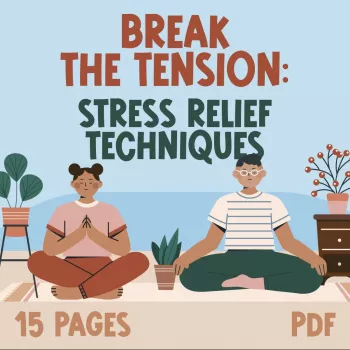
- Break the Tension: Stress Relief Techniques – Breathing Exercises, Quick Meditations, Grounding Techniques, and Time Management Tips to Reduce Stress (a structured, easy-to-skim guide you can turn into phone notes or cue cards)
- Calvin Klein Jeans Women’s Black and Pink Printed Shoulder Bag (useful for carrying a small grounding item, notebook, or “reset kit” essentials on busy days)
FAQ
How fast can breathing exercises reduce stress?
Many people notice a shift within 30–120 seconds, especially when the exhale is longer than the inhale. Results tend to improve with repeated practice and relaxed, unforced breathing.
What should be done if grounding techniques don’t work in the moment?
Switch to a simpler anchor (pressing feet into the floor or naming three facts about the present), add a temperature change like cool water, and reduce stimulation if possible. If symptoms are intense or frequent, consider professional support.
Which is better for stress: meditation or time management?
They work best together: breathing and meditation lower immediate intensity, while time management reduces recurring triggers by adding clarity, boundaries, and realistic plans.









Leave a comment